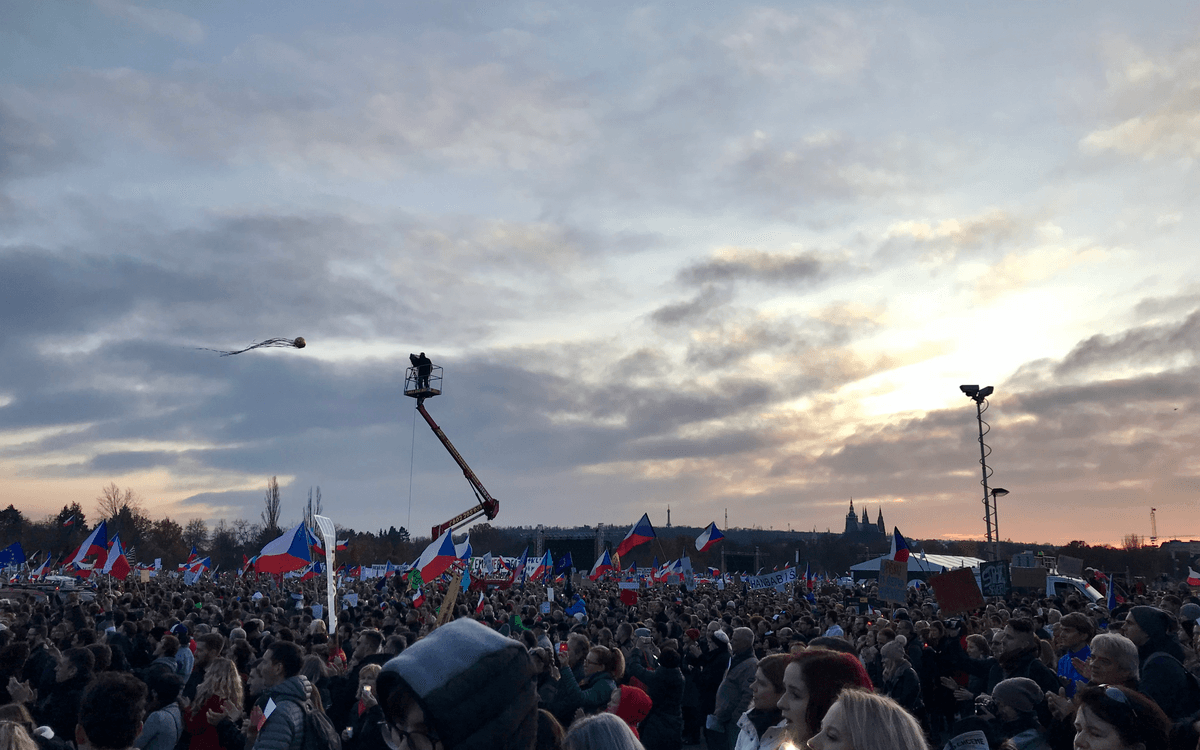
Hundreds of thousands gathered on Prague's Letná Plain on Sunday, 15 November 2026, to oppose the Czech government's plan to abolish public broadcasting licence fees and finance national television and radio through the state budget. The organising group Million Moments for Democracy estimated attendance at 350,000 to 450,000. There is no official verified crowd count: Prague police said they do not publish estimates. The legislation has advanced in parliament but has not yet become law.
Why the funding model is contested
Česká televize (ČT) and Český rozhlas (ČRo) currently receive a substantial share of their income from statutory household fees. The monthly charge is 150 koruna for television and 55 for radio, a combined 205 koruna per liable household. That arrangement is intended to distance their financing from annual political budget negotiations. Prime Minister Andrej Babiš's governing coalition proposes abolishing the charges and paying the broadcasters from the central budget instead.
Opponents fear the move could make both revenue and editorial independence more dependent on whichever cabinet and parliamentary majority sets appropriations. Media representatives and critics suggest the proposal could reduce funding by roughly 15%. That figure describes an anticipated consequence of the plan, not a cut already recorded in public accounts. A licence fee does not automatically guarantee independent journalism. But separating revenue from yearly government bargaining may constrain opportunities for financial pressure.
The parliamentary procedure is another source of anger. Following an overnight debate, the government majority moved the measure through an early legislative stage at 4:36am. Organisers made that time the rally's emblem: Letná against 4:36. This was not the bill's final passage. Both the eventual financing formula and accompanying safeguards remain subject to further legislative decisions.
Key facts
- Demonstration: Organisers estimated 350,000-450,000 participants on 15 November; police did not confirm an attendance figure.
- Legal status: The funding overhaul passed an early parliamentary stage, not the complete legislative process.
- Current fees: Television and radio charges are 150 and 55 Czech koruna respectively, or 205 combined each month.
- Government response: Babiš insists he will abolish fees but denies seeking control over editorial decisions.
Demands, rebuttals and the next parliamentary test
Million Moments for Democracy wants the draft withdrawn, an apology for the overnight handling and substantive public dialogue. Its campaign website portrays the reform as part of a wider conflict over the independence of democratic institutions. Those are the organisers' political allegations, not established findings by a court.
According to the Czech news agency ČTK, movement chairman Mikuláš Minář invited government representatives to a public discussion at Prague's Švanda Theatre at 7pm on 2 December. The campaign also demands the departure of Tomio Okamura of the Freedom and Direct Democracy party from the speakership of the lower house and attacks his party's role in defence and security policy. The demonstration is thus a broader challenge to the governing coalition rather than a dispute over household bills alone.
Babiš rejected the protesters' account. He said he respected the right to demonstrate but disagreed with their reasons, according to ČTK's reporting of his response. He argues that replacing fees will modernise an outdated system and fulfil an electoral pledge, and insists the government will neither nationalise public broadcasters nor dictate what journalists publish. It would be premature to conclude that any budget-financed broadcaster necessarily loses independence. Equally, a political assurance not to interfere is not itself an enforceable safeguard for financing.
The organisers' estimate would make the rally potentially one of the country's largest since the democratic changes of 1989. Because police provide no official headcount, precise historical rankings cannot be independently confirmed. ČTK reported that the gathering was largely peaceful, with police handling only minor incidents. The scale indicates considerable public opposition, but does not resolve the remaining parliamentary questions.
The next tests concern the actual text approved by legislators: how allocations are calculated, whether they are adequate and predictable, and what rules insulate financial decisions from partisan pressure. Until the final vote and implementation, abolishing the fees remains a government proposal, not a completed transition to state-budget funding.