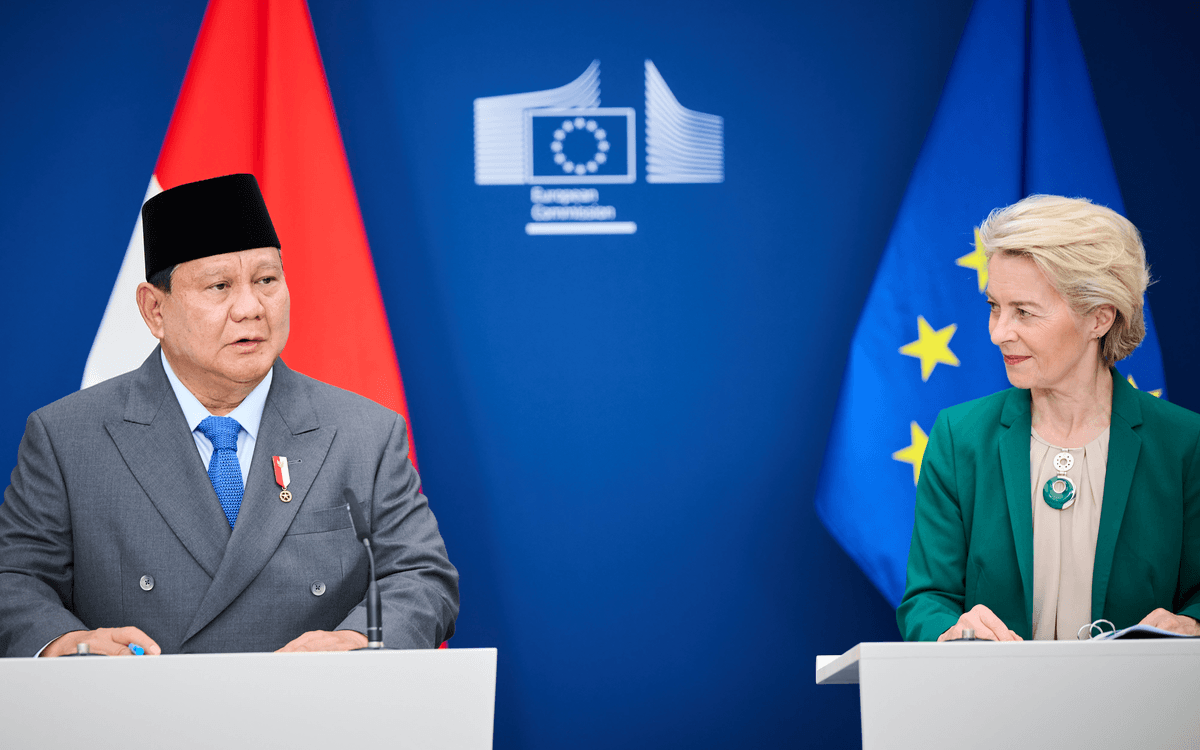
The European Union and Indonesia signed a comprehensive trade agreement and a separate investment-protection agreement in Brussels on Saturday, 21 November 2026, according to reporting on the ceremony. The signatures complete a long negotiating process. They do not automatically activate the promised tariff reductions. For companies, the difference between signing and application matters.
The Council of the EU authorised the signature of both treaties on 18 November. It also authorised the possibility of provisional application. Final conclusion still requires the European Parliament's consent. Provisional application will start only after the EU and Indonesia have each completed and notified the other of the procedures needed for that stage.
Key facts
- Agreements: The EU and Indonesia signed the Comprehensive Economic Partnership Agreement (CEPA) and the separate Investment Protection Agreement (IPA) on 21 November 2026.
- Tariff coverage: Up to 98.5% of tariff lines would be liberalised once fully implemented, and 96% of Indonesian tariffs are expected to disappear within five years.
- Forecast: The Council estimates roughly €600 million annually in saved customs duties, not savings already achieved.
- Legal status: European Parliament consent and further procedures are still required; signatures alone do not make tariff reductions effective.
What would change for trade and investment
Indonesia is Southeast Asia's largest economy. Some European manufactured exports currently face substantial import duties there. The Council says tariffs on EU vehicles can reach 50%. The agreement envisages eliminating them over five years. Machinery, electrical equipment, chemicals, pharmaceuticals, textiles and footwear are also among the sectors expected to benefit from better access.
The 98.5% figure is a share of tariff lines, not the proportion of today's trade value suddenly exempt from duties on Saturday. Many concessions have phase-in periods. The number therefore cannot establish an immediate change in retail prices or a specific increase in German exports. Businesses will need to inspect product-level schedules and eligibility conditions before calculating savings.
Beyond goods, the agreement covers services, intellectual property and access to public procurement. Indonesia is to protect 221 EU geographical indications, intended to help protect products associated with particular European locations or methods against imitation. The EU has also reserved exceptions: rice, sugar and ethanol are excluded from broad tariff liberalisation, while some other sensitive agricultural products will face limited tariff-rate quotas.
The investment agreement provides protections against unlawful expropriation and establishes fair-treatment principles. It expressly recognises the parties' right to regulate for public-health and environmental objectives. A comprehensive new investor-state arbitration procedure does not arrive automatically with the signatures. Instead, the text envisages voluntary mediation and further negotiations on possible dispute settlement arrangements.
Why the start of 2027 matters
Indonesia is scheduled to graduate from the EU's Generalised Scheme of Preferences on 1 January 2027, losing preferential tariff treatment for some exports. Brussels and Jakarta therefore have an incentive to avoid a gap between the old concessions and any new framework. A political ambition to begin applying the agreement in early 2027 is not a confirmed legal start date.
Trade negotiations began in July 2016 and were concluded in September 2025. According to the Council, bilateral goods trade reached €28.9 billion in 2025. Services trade was €9.3 billion in 2024. Those figures refer to different categories and years; they should not be combined as if they described a single year's total.
Euronews reported, citing the European Commission, a projection that EU exports to Indonesia could grow by almost 40% within 15 years. It is a long-term estimate conditional on implementation, not an observed change in November 2026. An Indonesian business service had reported preparations for ratification before the ceremony, underlining that the signing is not the final procedural step on either side.
The next decisions belong to the relevant institutions and the domestic processes of both parties. Only after the necessary notifications can the provisional trade rules begin. That will establish when companies can actually claim the promised reductions instead of merely planning for them.